The Literary Consultancy celebrates its 30th anniversary in 2026
2026 sees the 30th anniversary of The Literary Consultancy, the UK’s longest-established editorial consultancy. Founded on psychoanalytic principles in 1996, TLC has since supported over 13,500 writers through its core services of editing, mentoring and events. Since 2020 it has also run a membership programme for writers that focuses on how writers can create happier, healthier habits (Being A Writer), and it now also offers consultancy services to publishers, agencies and other literary businesses. These new strands of business activity have been launched under the directorship of Aki Schilz, who took over the company from its founder Rebecca Swift in 2017.
In this anniversary year, TLC will:
- Launch The Literary Conversation, a limited series podcast with guests Damian Barr, Kamila Shamsie, Lemn Sissay, Lucia Osborne Crowley, Gavin Clifton and Tash Aw
- Launch a Climate Action Toolkit for Writers, co-devised with climate action researcher Zoe Rasbash
- Programme a range of free and low-cost interventions for writers focusing on wellbeing including a Creative Wellbeing Salon and an interactive webinar with Centre for Mental Health writer in residence Andrew Kaye Kauffman
- Celebrate 25 years of its bursary scheme for low income and marginalised writers, currently funded by Arts Council England
- Celebrate 10 years of partnership with novelist Michael Langan on the TLC LGBTQ+ Free Reads programme
- Host a Symposium on literary culture in November, featuring original pieces by TLC alumni on the value of literature in their lives
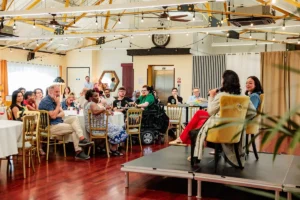
- Celebrate 30 years supporting the writing community at an event in London with readings from TLC alumni Patrice Lawrence, Winnie M Li, Yin F Lim and Jamie Hale.
TLC Director Aki Schilz said:
“In the three decades that TLC has been working for and alongside the literary community much has changed, but in some ways the persistent blocks remain. Despite a wealth of information and committed efforts to ‘demystify’ publishing, in some ways the barriers to entry are more stubborn than ever. From Covid to AI, the anxieties are real and demoralising. Still through it all, we have seen the incredible resilience of writers determined to tell their stories and publishers big and small committed to bringing those stories to life. We have been lucky to work on both ends: with writers, to develop their work, and with publishers, training their editorial teams and providing high quality editorial support. There is much to feel hopeful about. Our position is unwavering: we believe in writers. We believe in literature. We believe that every story deserves to be told. In a world seemingly in constant flux with disruption and innovation flung lightly as buzzwords, we are proud to be the writer’s North Star.”
TLC’s list of alumni across its services and community include:
Megan Davis, The Messenger, Zaffre
Sarah Mellor, The Departed, HarperNorth
Rachel Bower, It Comes from the River, Bloomsbury
Lachlan McIver, Life & Death Decisions, Hachette
Audrey Chin, The Ash House, Penguin Random House SEA
Elsepth Wilson, These Mortal Bodies, Simon & Schuster
Yin F Lim, winner of the Mo Siewcharran Prize
and many hundreds more.
Q&A with Aki Schilz
1. What makes TLC special?
TLC has always been in the writer’s corner. Consistently for three decades, we have positioned ourselves as on the writer’s side – a critical friend, not a gatekeeper looking to rubber-stamp their work as Good or Bad. Crucially, we have always prioritised process over product, right from our inception: we’re not just interested in what writers are writing, but also about why they write, and how. The initialism TLC was a happy accident – we have often joked that it should stand for Tough Loving Care. But in our view that is always the best approach. Truth-telling, non misleading, never exploitative and always working for the writer’s best interest, fully respecting their vision, their dreams, and their version of success: be that to sell books, to work through internal processes, to leave a gift for their children, or simply to write, because it’s what they love most.
2. What does the future have in store?
As the world begins to wake up to the importance of storytelling across all formats (from how businesses storytell to gain and retain customers, to service providers thinking about how to ensure their content meets their users’ needs), we are very proud to be evolving the TLC for Business side of our operations. We have thirty years of experience working directly with writers and have a finger on the pulse of what the patterns and trends are – creative writing has a knack for not just reflecting the Zeitgeist, but embodying it. We know how writers write, how readers respond, and what works and doesn’t. We know how important excellent writing is, and how vital good editing is too. We’re really proud to be working with partner businesses who look to us to support them with their editorial processes – right the way through from robust copy-editing and proofreading for publishers, story-building support for busy agents with talented clients, and even supporting organisational clients with editorial strategy and editing training. We’ve worked with international prizes, major literary agencies, global publishers, and even film production companies. We’ve trained editors and writers, we’ve provided sponsored services, we’ve facilitated workshop and webinars. We’re looking forward to forming new partnerships with those who are looking to support writers, and champion the best writing of tomorrow.
3. In a world of AI, why is TLC so important?
Whilst we are still learning about the threats and potential opportunities of large language learning models, it is clear that for now the advancement of AI without proper regulation is a direct threat to writers and creatives. It not only farms intellectual property without any heed of the legal protections of copyright (or in spite of them), but it also poses a direct threat, when unregulated, to the creative imagination of writers and storytellers whose livelihood depends on us as a society valuing that endeavour; that labour. There are also of course the enormous ecological impacts which in a world in climate crisis feel untenable to justify. We have always positioned ourselves as in the writer’s corner, and that hasn’t changed. We believe in the value of human connection. AI might be powered by people (and indeed by people’s biases) but it cannot replace or substitute human connection. Editing is a magical mix of empathy and skill. It is one human bestowing on another the highest form of attention. One that says, I see you, I hear you, let me help you get this idea out of your head and onto the page. Let me honour that the work is yours, not mine. It is not co-creation. It is a vital human support system for those who typically work alone and who need, above all, real connection. We cannot lose that. I truly believe that what our editors give our writers, cannot be replicated. And neither can (or should) works of great literature. Because after everything, that’s what we do this for. We do this because we love writers, and we love writers because we love literature. It speaks to us, because it is us. And it shows us what we might yet be.
Aki Schilz is available for interview and to write pieces. For further information, please contact Anna Pallai at