
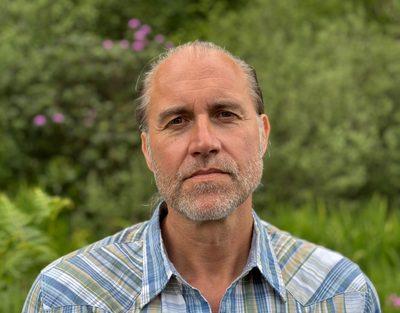
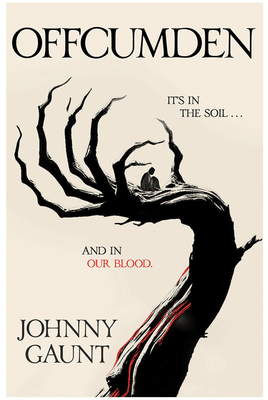
In 2022, writer Johnny Gaunt won TLC’s Pen Factor Writing Competition, with an extract of his then unpublished literary folk horror Offcumden. We’re delighted to share that Offcumden is now slated to be published by Transworld next year on 1st April 2027, and is available to pre-order now. This news coincides nicely with the return of the TLC Pen Factor Writing competition (open to Being a Writer members and ticketholders to our Conscious Writing Month), so we thought we’d interview Johnny about his writing, the TLC Pen Factor, and the state of horror writing.
Writing From the Ground Up: Johnny Gaunt on Horror, Class, and Winning the TLC PEN Factor Competition
1. Can you tell us about Offcumden and what readers can expect from the novel?
Offcumden is a literary folk horror novel set on and around a Rotherham council estate. The title is a Yorkshire dialect word for an outsider — an off-comer — and that tension between belonging and not belonging is at the heart of the book. It’s a story about place, about class, about the way communities form around a shared land and a shared history. And it’s a story about what happens when something very old and very dark gets buried underneath all of that. As with most horror, that darkness is metaphorical. The story uses horror to look at gender, identity, and aspects of community that we may not want to look at. Aspects that can carry down through generations.
2. What were the key stages in your journey from writing Offcumden to securing a two-book deal with Transworld?
The MA in Creative Writing at Manchester Metropolitan University gave me space and time for some serious critical engagement with writing. Just before graduating in 2022, I won the TLC Pen Factor Writing Competition and it was this that told me my work — though still at a rough stage — was good enough to make people in the literary world prick up their ears. The mentorship with Ray Robinson the prize afforded me was genuinely game changing, and Ray and I have remained good friends since.
When I first began querying agents I was surprised by the positive responses. Initially I signed with an agent from a large agency, but we had parted ways within a year. Fundamentally the more drafts we made of the manuscript, the more I felt it drifting away from my own vision of it. However, as soon as I started talking with Jamie Cowen at The Ampersand Agency there was clear alignment. Jamie understood what I was trying to do and from that point things started to fall into place. We began again with my original version of the book, and the deal with Transworld happened only a few months after our one and only round of editing.
3. How has TLC supported you during your writing journey, and what difference did that support make?
The TLC Pen Factor recognition came at exactly the right moment. When you’ve been writing for a long time in relative isolation, having an organisation like TLC tell you the work has real merit matters more than you might imagine. During the mentorship with Ray we engaged with the novel at a serious level and this made me raise my game and change how I approached working on the book. I became more disciplined, more diligent, making sure I turned up every day to work in good faith. I think that really tells you something about the quality of the programmes TLC has in place.
4. What have been the biggest challenges or setbacks, and what helped you keep going?
I’m a full-time NHS Professional, writing around shift work and the usual demands of a family — I’m a husband and father to two teenage girls — the real world poses challenges enough! And this is the same for most writers, published or otherwise. However, these last few years I’ve come to realise that my family — as difficult as the juggle can occasionally be — is the stable platform that allows me a solid base to write from.
During the months with my first agent, when Offcumden went out to publishers and seemed to be just missing the bullseye with so many editors, it was easy to slide into a dark place where my ever present imposter syndrome (I’ll speak more about him later) seemed to be getting a huge amount of my mental space. Friends and close family really helped at this time. They kept me distracted and busy with other things. And I never abandoned the writing: new stories, fresh ideas, even if those pieces didn’t come to anything, the writing process kept me grounded and allowed me to stay in touch with that creative part of myself.
5. Why do you think horror is having such a strong moment in publishing at the moment?
Historically, horror has always had its revivals during periods of social and political disruption. The nineteenth century’s fascination with gothic horror coincided with anxieties about revolution, industrialisation, urbanisation, and scientific progress that threatened religious belief. Jump forward to the 20th century and the horror of the 50s and 60s reflected a fractured society grappling with the civil rights movement, political assassinations, and the Vietnam war. The 70s and 80s saw further social upheaval and the looming presence of nuclear war. We’re in another one of those periods now. People are existentially frightened, and horror is one of the few genres that is prepared to seriously examine what that fear is.
6. How has your working-class background influenced your writing and the stories you want to tell?
I grew up reading lots of horror during the 70s and 80s — a purple patch for the genre. I started writing my own stuff when I was about fifteen: jotters filled with scribbles, short stories sent to small-press magazines. There were many years of attempts and frustrations. Long periods of feeling pretty down about it. It was a difficult time in a lot of ways, but now — with the benefit of age and experience — I can see that all of that turbulence — all of that living — was actually a plough blade, turning over the soil of my mind. Cultivating it. Making it more fertile for stories to grow.
Wherever you happen to grow up, the landscape of the place will find its way into whatever you decide to create. And growing up with a working-class background gives you a particular relationship to place. It does something to the way you understand a city, or a town, or a village. It allows you to see those places — and the people who live in them — from the ground up. Places like Rotherham are rarely ever written about in fiction, and when they are it is often from the distance of another class. I wanted to write something from my own perspective — from the ground up — keeping the history and culture intact, whilst opening that world up to the dark beauty of horror.
7. What do you think working-class voices can bring to horror that the genre needs more of?
Essentially, the working-class voice creates a new kind of relationship with horror. It shifts the things that the genre is actually about — trauma, powerlessness, the body, the land — and rearranges them to create its own dark view of what it is to be human. A working-class perspective will always offer something fresh to art — if only because it is so rarely invited to do so.
As for what the genre needs more of, I think there’s something important to be said about place. Offcumden uses the council estate essentially as a gothic horror setting. People forget that the great estates were built as a progressive dream, something genuinely radical: an idea that working-class people deserved decent homes, light, space, gardens, and communities designed for human flourishing, rather than profit. But the past four decades of systematic government failure has seen that vision crumble. Now, the very term ‘post-industrial town’ carries with it a sort of nostalgia, a haunted, over the shoulder view from the remains of a once beautiful dream. This notion of decaying beauty — of the sublime — is what lies at the heart of the gothic idea.
8. What advice would you give to aspiring horror writers from working-class backgrounds trying to get published?
Two things.
One. Write the thing only you can write. Never let ideas about ‘the market’ take root in your head. That will only ever lead to yet another version of something that’s already out there (and, in all likelihood, not a particularly good version). There’s a temptation, when you don’t see much working-class horror on the shelves, to see that absence as a ‘verdict’ — as if the gap exists because nobody wants it, or because it doesn’t work. I think the gap is exactly why it’s worth writing into. It means the stories aren’t being told, not that they shouldn’t be. Concentrate on writing the story that comes from your own place, your own experience, your own obsessions — write it authentically, in your own voice, and you’ll write something nobody else could have.
And two. Expect imposter syndrome… and use it. I think this hits working-class writers harder than most — rarely do working-class folk grow up being told the world of literature is a place they belong. And it doesn’t necessarily go away with age or a book deal. The trick, I think, is not to try and get rid of the damn thing — that’s probably a lifetime of therapy, right there. It’s more about accepting it. And a good start is to give it a name and flesh him/her out in your mind. Mine is called ‘Mr Doubt’ and he wears a ragged old jester suit. When you accept he’s there, all that’s left is your response. Oh, this is no good, is it? Well, I’m gonna stick it in anyway and I’ll get back to your insightful comments later. Let the imposter talk all he wants — just don’t let him hold your pen. Write with him sat right there beside you because occasionally he might have something worthwhile to say! You’ll get better at working out which of his critiques are worth listening to. Just remember he doesn’t get the final say: you do.
Offcumden is available to preorder from Transworld now.
Enter the TLC Pen Factor Writing Competition 2026. *You must have a ticket to Conscious Writing Month, or be a member, to enter. Please read the full submission guidelines before entering* The Submission Deadline for the 2026 Prize is 9am (UK) 16th November 2026. Find out more.
Find out more about TLC Mentoring.