
Have you ever thought of your writing as an excuse to go on an adventure?
Your personal excuse to retreat from the world and delve into a topic that fascinates you. To undertake an unusual trip for the sake of the research. To go beyond your comfort zone and be braver than you normally would in real life.
We write for many reasons – for self-expression, for artistic purpose, for emotional release – but our writing can also empower us to go on an adventure, both in our minds and our real lives.
Each of my three novels has given me that opportunity to explore. Yet with my most recent one, What We Left Unsaid (2025), I took that sense of adventure to a new extreme. After years of writing about trauma and its lived consequences, I wanted to write something more fun and light-hearted on the surface. So if you asked me why I wrote my most recent novel, this would be my most honest answer: to have an excuse to drive Route 66.
Is it selfish to write a novel for this reason? Or self-indulgent? I think not, because at the end of the day, we as writers thrive on curiosity and discovery. But the project of writing also gives us a legitimacy to pursue our most hare-brained ideas.
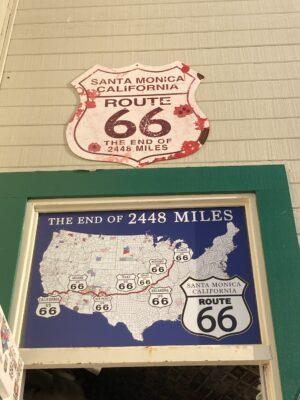
For years, as an ex-pat American living in the UK, I had always been curious about driving Route 66. But it had never occurred to me to actually go on that particular road trip until I had a specific reason: as research for my next novel. Otherwise, I’m not sure I would have felt justified to spend a few weeks in the United States, booking flights, Air BnBs, and hotels in the midst of Covid.
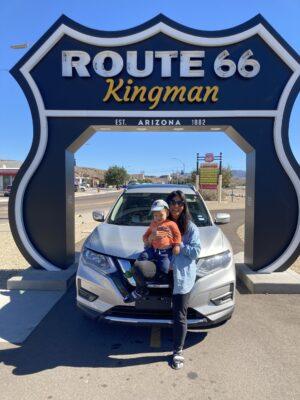
It also became a family holiday (albeit a logistically complicated one), as I somehow convinced my partner that flying out to Chicago with our then 22-month-old toddler, hiring a car, and driving 3,400 miles to Los Angeles over three weeks would be fun. We survived – and came back enriched with indelible memories, improved driving skills, and a real glimpse of contemporary America.
But through it all, the act of going on that road trip also gave me the material to nurture my novel. The characters in my novel (three estranged adult siblings) are quite different from my own travel companions, but somewhere in that liminal space between my lived experience and my imagination, I was able to dream up a story. As I drove across nine states with my family, passing through cities and prairies, deserts and canyons in a hired SUV, I filed away all these places as potential settings for my fiction. And when I sat down to draft my novel (a process that took me from Christmas 2021 until June 2024), the memories of the long dusty miles on the Interstate, the roadside diners, and quirky motels fuelled the authenticity in my writing.
If you have a wild research idea for your next writing project, here are five reasons to convince you to go on that adventure:
A Writing Project Needs to be Powered by Passion
As individual writers, we need something to motivate ourselves through years of working alone on a project: the writing, the re-drafting, the search for a book deal, and then when it is published, the promotion and publicity. And that drive ideally comes from a place of passion and curiosity. It’s even better if it’s rooted in a lived experience that marked a new moment of discovery for us.
Life is Short – Take That Trip You Always Wanted to Do
As adults, we rarely give ourselves the chance to indulge in our personal interests – household budgets, family schedules, professional and caring responsibilities often prevent us from going on an adventure. But if you fold your dream trip into a research project, you can align your personal and artistic ambitions – and hopefully, not feel guilty about it.
The Joy and Excitement Will Show Up in the Writing
We often talk about the discipline and persistence required of a writer – drafting your 1000 words for the day, carving out an hour in the early mornings – but joy and excitement are important elements in our writing, too. For me, I’d like to think the thrill of travelling to new places invested my words with more vivid emotions, richer details, and a super-charged imagination.
Writing Expenses Count in Your Tax Bill
This one is boring, but practical. If you file your taxes as a self-employed professional, any reasonable costs towards a research trip (flights, car hire, admissions tickets, meals) can count as work expenses and help reduce any taxes you might pay on your self-employed income. So save those travel-related receipts!
Multiple Benefits from Your Writing Project
What if, at the end of all that research and writing, your manuscript fails to find a publisher? Unfortunately, that can happen, and it can always be chalked up as a ‘learning experience.’ But even if you don’t become a published author from this project, at least you got to go on a real-life adventure.
Any major writing project is a risk: the time and effort invested, the emotional involvement, the question of whether or not you might get a book deal. So honour that risk you’re undertaking as an aspiring author. But also remember: writing requires self-discipline and hard work. You may as well have some fun along the way!
Winnie M Li is the author of three novels and Assistant Professor in Creative Writing at the University of Birmingham. A former film producer, her debut Dark Chapter won The Guardian’s Not The Booker Prize, was nominated for an Edgar Award, and translated into ten languages. She has since adapted it for the screen. Her follow-up Complicit was a New York Times Editors’ Choice and shortlisted for the Royal Society of Literature’s Encore Award. Her most recent novel What We Left Unsaid is out in paperback now. Winnie holds a PhD from the London School of Economics in Media and Communications and an honorary doctorate from the National University of Ireland.